The Discovery of Electromagnetic Induction
Michael Faraday, a prominent 19th-century scientist, made history with his pioneering discoveries in the fields of electromagnetism and electrochemistry. His most significant contribution is the discovery of electromagnetic induction, which had a far-reaching impact on the development of modern technology.
Electric Current in a Coil
Faraday's work in the area of electromagnetic induction included experiments in which he demonstrated that a moving magnet can induce an electric current in a coil. This phenomenon, now known as Faraday's law of electromagnetic induction, is the foundation for the operation of electric generators and transformers, which are crucial for the production and distribution of electrical energy.
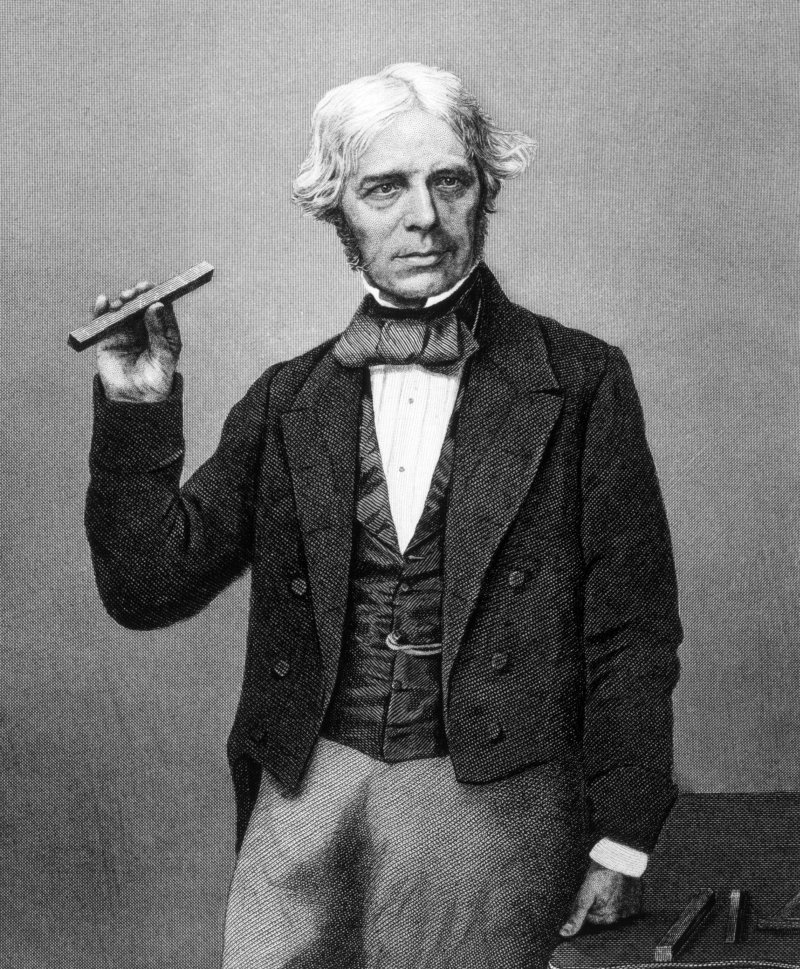
I have at last succeeded in illuminating a magnetic curve or line of force and in magnetising a ray of light.
– Michael Faraday
Electromagnetic Fields
Faraday also laid the groundwork for understanding magnetic and electric lines of force, which enabled a better comprehension of magnetic and electric fields. His ideas about lines of force not only helped clarify how electromagnetic fields work but also represented a significant step in the development of theoretical physics.
Farad
In honor of Michael Faraday, the unit of electrical capacitance is named the farad. The farad is defined as the ability of a capacitor to store an electric charge of one coulomb at a voltage of one volt.
Induction Coils
Faraday's discoveries have a direct impact on induction coil technology, which is used in many applications, including iron melting. Induction coils utilize the principle of electromagnetic induction to create a strong magnetic field, which then generates the temperature needed for melting metals. These coils are crucial for modern metallurgy and iron production, reflecting Faraday's lasting influence on science and technology.
- Zdeněk Veitz


